What do a family physician who writes poetry, a physicist who makes ceramic art, and a screenwriter who studies science research have in common? A belief that some of the best learning happens at the intersection of art and scholarship.
Enter Stanford Arts Institute’s artsCatalyst fellowship, a program that gathers instructors from across campus looking to integrate the arts with teaching and research. The program’s ultimate goal is to provide undergraduate students with coursework that expands their thinking and encourages creative problem solving.
“I’m a big proponent of the idea that even if it doesn’t connect to what you do as a scientist or scholar of any kind, having a creative practice is beneficial and good for you,” said Hideo Mabuchi, professor of applied physics in the School of Humanities and Sciences and faculty director of Stanford Arts Institute. “I don’t try to make any connection between what I do as a craft maker and what I do as a scientist, but doing those two very different things inevitably broadens your perspective.”
The fellowship welcomed its first cohort of 15 in the fall 2025 quarter. Coming to artsCatalyst with a plan for developing an interdisciplinary arts course was a key requirement for the fellowship.
Learn more and apply
Applications for artsCatalyst course enhancement grants, which support arts experiences in Stanford undergraduate courses, are open now through Feb. 20.
Applications for the 2026-2027 cohort of artsCatalyst fellows will open in spring quarter.
“We brought together a cohort of people who are deeply engaged in interdisciplinary arts integration in the teaching that they do,” said Mabuchi, who leads the fellowship’s sessions throughout the quarter. “Together we meet to talk about best practices, workshop with each other, and share motivations and experiences.”
Two parts of a whole
For Diana Farid, a clinical associate professor of medicine, her interest in the arts began as a self-sustaining practice while she was in medical school.
“Looking back, it’s kind of obvious I was seeking out art as a way of maintaining a sense of personhood,” said Farid, who is also a poet and award-winning author.
“I went to Spain between my first and second years of medical school instead of working in a lab, under the heading of learning medical Spanish, but in reality I was going to the art museums, and taking flamenco dance classes,” she said.
She’s currently developing a course that explores what the process of reading and writing poetry reveals about healing, health care, and medical science.
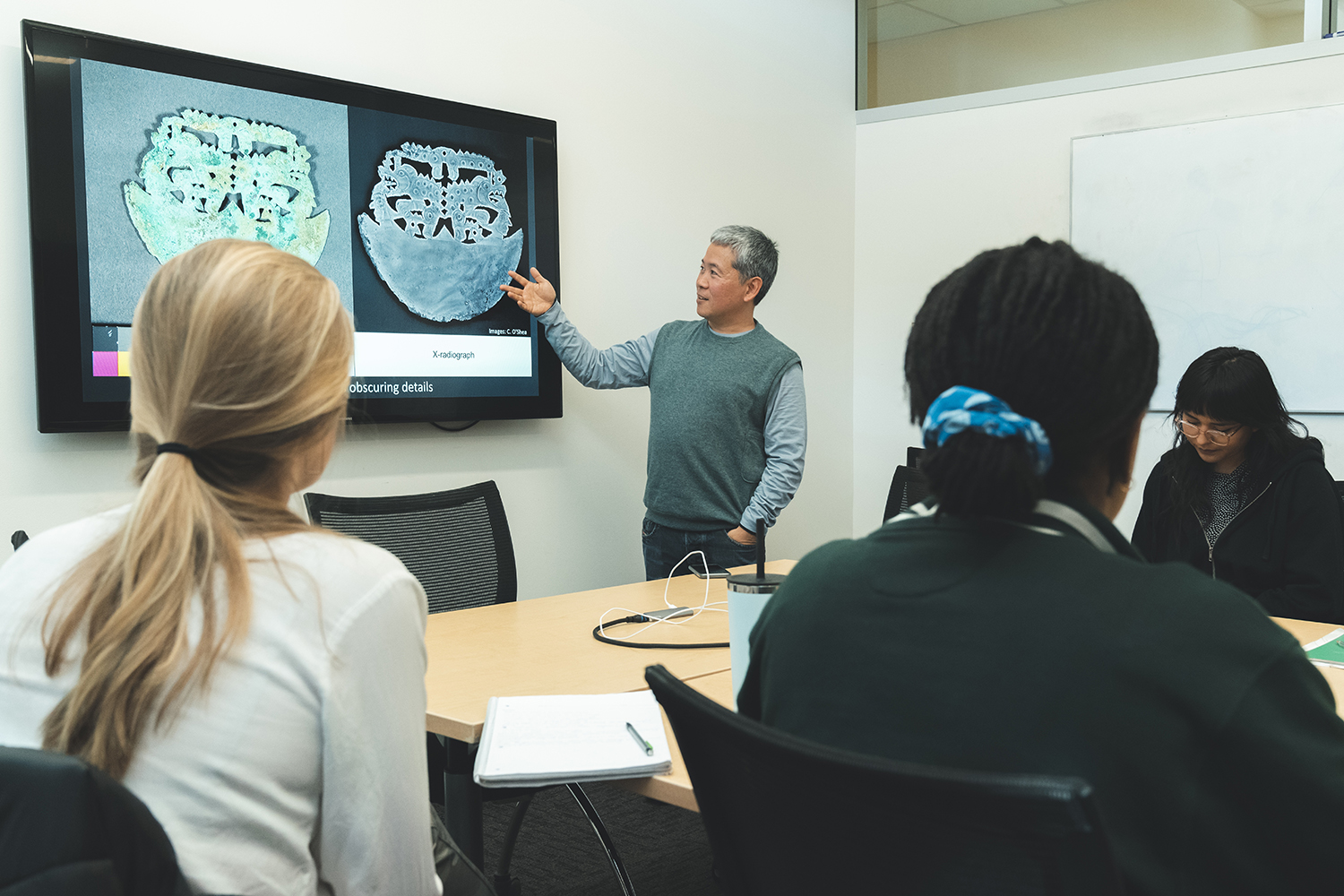
Stanford Arts Institute Faculty Director Hideo Mabuchi co-teaches “Physical Analysis of Artworks,” a course developed with the Fine Arts Museums of San Francisco and the Stanford Nano Shared Facilities. | Andrew Brodhead
“I think what’s really fundamental about being able to be involved in interdisciplinary or arts-type courses is that it allows you to be open to the unknown and think creatively,” Farid said. “It also helps you understand that there are multiple ways of coming to answers outside of the methods within your specific field.”
Adam Tobin, a senior lecturer in art and art history, teaches courses in screenwriting and film production. He joined the artsCatalyst fellowship because he wanted to tap into the science research being done across campus to help students translate it for the screen.
Through the fellowship, he says he’s benefited from participating in a space where both creative and scientific scholars could share and gain insights.
“One of the ideas that came up among some of the STEM faculty in the artsCatalyst fellows was that we’re all natural artists, and we all have an artistic spirit that can be tapped,” Tobin said. “And my response was that we’re also all natural scientists, in that we’re always asking questions.”
Art, AI, and the future of education
As a classically trained violinist and associate professor of African and African American studies, Matthew D. Morrison plans to use his time as an artsCatalyst fellow as a launch pad for a spring quarter course that will explore ethical and commercial concerns around AI and popular music.
“I think for us at Stanford, the more your work is informed by other perspectives, the more questions get raised, and the more answers that one can see,” said Morrison, of his experience collaborating with artsCatalyst fellows.
“One of the things I’ve taken away is the level of intellectual curiosity, generosity, and brilliance of my colleagues in all of their specific fields, and how thoughtful they already were in thinking about the relationship between the arts and their fields of study,” he said. “While one cannot master every field, collaboration is the main way someone can get to an integrated way of thinking and form a more creative way of moving through one’s process.”
Mabuchi says that rather than fellows cycling out, he wants the artsCatalyst community to continue to grow each year, allowing instructors to build on and disseminate interdisciplinary arts teaching throughout the university.
“We’re really trying to think through how higher education needs to evolve because of advances in AI,” Mabuchi said. “And I become more and more convinced through experiences like artsCatalyst that a big part of the response should be integrating art, and making things, more deeply into Stanford’s core mission of research and teaching.”
Writer
Olivia Peterkin